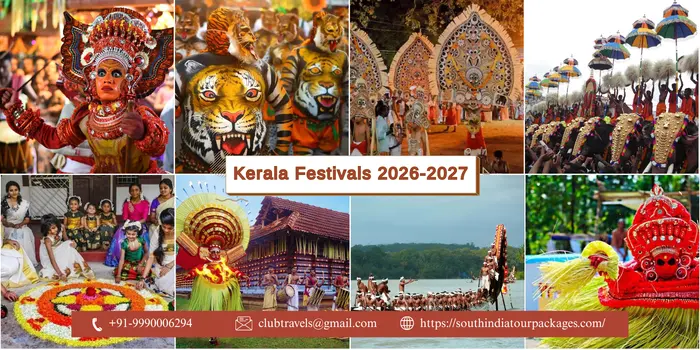
Kerala is more than just a holiday destination; it is a soulful experience that is woven with tradition, vibrant colors, classical music, and spirituality. Kerala is called “God’s Own Country” and is a tropical haven that is full of more than just natural beauty. If one is looking to explore India in its truest form, then planning a trip to Kerala during their festivals 2026-2027 is sure to make their experience one that is truly unforgettable.
From the prestigious Kerala temple festivals to the electrifying snake boat races, to the captivating dance forms like Kathakali and Theyyam, every festival is a reflection of Kerala’s heritage. From the globally acclaimed Onam festival in Kerala to the Thrissur Pooram festival, to spiritual festivals, Kerala’s festival calendar is full of experiences that make it a holiday destination for tourists from across the world.
For tourists visiting from across the world, Kerala’s cultural festivals are a golden opportunity to witness Kerala’s culture, traditions, and cuisine, and to experience the vibrant culture of India. A visit to Kerala during their festivals is sure to not just help one see Kerala but to experience it in its truest essence.
Festival calendar of Kerala 2026-2027
| Date | Festival Name | Venue |
| April – May (exact dates to be finalized) | Malabar Kite Festival | Pallikkara Bekal Beach Park. Bekal, Kasargod |
| 26th April 2026 | MaThrissur Pooram | Vadakkumnathan Temple, Thrissur |
| 27th April 2026 to 07th May 2026 | Edathua Perunnal | St. George’s Church, Alappuzha District |
| 7th & 8th May 2026 | Puthupally Perunnal | St. George Orthodox Church, Kottayam District |
| 25th May 2026 | Kannambra Vela | Sree Kurumba Temple, Palakkad District |
| 29th May 2026 – 24th June 2026 | Vaishaka Mahotsavam | Kottiyoor temple, Kannur District |
| 15th – 16th June 2026 | Ochira Kali | Ochira Parabrahma Temple, Kollam District |
| expected between July 7 and July 10, 2026 | Champakulam Boat Race | Pamba River in Alappuzha, Kerala |
| 17th July 2026 | Aanayoottu Festival | Vadakkumnathan Temple, Thrissur |
| July 2026 | Malabar River Festival | Iruvanjhipuzha & Chalipuzha Rivers at Thusharagiri, Kozhikode |
| 8th August 2026 | Nehru Trophy Boat Race | Punnamada Lake in Alappuzha, Kerala |
| 16th August 2026 | Athachamayam | Thripunithura, Ernakulam |
| 16th August 2026 – 26th August 2026 | Onam (Thiruvonam) | All over Kerala |
| 1st – 8th September 2026 | Manarcad Perunnal or Ettunoyambu | St. Mary’s Church- Manarcaud, Kottayam |
| 11th September 2026 | Neelamperoor Padayani | Palli Bhagavathi Temple, Neelamperoor, Alappuzha |
| 24th September 2026 | Feast of Vallarpadathamma | Basilica of Our Lady of Ransom – Vallarpadam, Ernakulam |
| 27th September 2026 | Aranmula Boat Race | Pampa River, Aranmula, Pathanamthitta (Near Alleppey) |
| 11th to 21st October 2026 | Navarathri Sangeetholsavam | Navarathri Mandapam – East Fort, Thiruvananthapuram |
| 11th to 21st October 2026 | Panachikkadu Festival | Panachikkadu Saraswati Temple – Kottayam |
| 10th and 11th October 2026 | Koratty Muthy Feast | St. Mary’s Forane Church – Koratty, Thrissur |
| 20th October 2026 | Aipasi Utsavam Aarattu | Padmanabha Swami temple, Trivandrum |
| 2nd November 2026 | Mannarasala Ayilyam | Sree Nagaraja Temple, Mannarasala, Alappuzha District |
| 14th – 16th November 2026 | Kalpathy Ratholsavam | Sree Viswanatha Swamy Temple, Kalpathi, Pallakad |
| 1st December 2026 | Vaikathashtami | Vaikom Mahadeva Temple, Kottayam District |
| 2nd December 2026 | Puthari Thiruvappana | Sri Muthappan Temple, Parassinikadavu, Kannur District |
| 21st November 2026 | Guruvayur Ekadasi | Shree Guruvayurappan Temple, Guruvayur |
| 11th – 18th December 2026 | International Film Festival | Trivandrum |
| 21st December 2026 | Niranam Valiyapally Perunnal | St. Mary’s Church, Pathanamthitta District |
| 23rd December 2026 to 1st January 2027 | Cochin Carnival | Cochin |
| 22nd February 2027 | Attukal Pongala | Attukal Bhagavathy Temple, Trivandrum |
Disclaimer: In Kerala, festival dates are determined based on the Malayalam calendar, as well as local traditions and customs. While the dates provided here are based on these references, they may vary depending on the specific rituals followed at each place of worship. Therefore, the dates mentioned should be treated as indicative and are subject to confirmation with local authorities. For exact festival dates, please feel free to write to us, and we will reconfirm them closer to the festival period.
Detailed Kerala festival 2026-2027
Malabar Kite Festival: April – May (exact dates to be finalized)
Venue: Pallikkara Bekal Beach Park. Bekal, Kasargod.
The Malabar kite festival is a colourful event co-organised by the Kasargod District Tourism Promotion Council, Bekal Resort Development Corporation, and the Bakel Lions Club. Kite enthusiasts from all around the world and the country demonstrate their skills by flying various types of kites. The lively celebration attracts hundreds of spectators and participants. The festival features massive kites representing animals (teddy bears, tigers), cultural icons (Kathakali masks), and unique designs like Russian, rainbow, and circle kites. Evenings include musical concerts (Ghazal nights), traditional dances (Bharatnatyam, Mohiniyattam), and specialized performances like Theyyam and Yakshagana.
Thrissur Pooram: 26th April 2026
Venue: Vadakkumnathan Temple, Thrissur
The Thrissur Pooram is widely regarded as the most spectacular temple festival in Kerala. It is celebrated with grandeur at the Vadakkunnathan Temple in Thrissur and was introduced in the late 18th century by Sakthan Thampuran, the Maharaja of Cochin. Thousands of spectators gather every year to witness this grand cultural spectacle. The festival features ten temples, with the main rivalry and processions involving the Thiruvambady Sree Krishna Temple and Paramekkavu Bhagavathy Temple.
- Kudamattom (Umbrella Exchange) : This visual centrepiece happens when 15 elephants from each side stand face-to-face. As the percussion builds, mahouts atop the elephants rhythmically exchange hundreds of uniquely designed, multi-tier, and even LED-integrated umbrellas. Designs are kept a closely guarded secret until the very moment of exchange.
- Ilanjithara Melam : Led by the Paramekkavu side, this is one of the world’s largest live percussion assemblies. Over 250 artists gather under the Ilanji tree inside the Vadakkunnathan Temple to perform a technical masterpiece of Pandi Melam for four continuous hours.
- Signature Fireworks (Vedikettu) : The fireworks are among Asia’s largest non-commercial displays, known for their unique “chemistry” of light and sound. Held at 3:00 am on the day following Pooram, this competitive display lasts for several hours and can be heard for miles.
Edathua Perunnal: 27th April 2026 to 07th May 2026
Venue: St. George’s Church, Alappuzha District
The Edathua Church, located on the banks of the Pamba River in Alleppey, is known for its structural prowess and serves as a representation of God’s own architectural heritage. It was built in 1810 and is dedicated to St. George. The festival begins with a flag hoisting on April 27, followed by special prayers, traditional band music, candlelight rituals, and a spectacular procession of the saint’s statue to the riverbank and back. The event features vibrant festivities, including a large trade fair, attracting thousands of tourists from South India.
Puthupally Perunnal: 7th & 8th May 2026
Venue: St. George Orthodox Church, Kottayam District
The famed Puthuppally Perunnal (perunal meaning feast) is a two-day festival full of magnificence and majesty. It is celebrated in the St. George Orthodox Church in Puthuppally. The big holiday parade, or Raza, sees the holy golden cross from the church brought to the neighbouring Puthuppally intersection. The procession is visually stunning, featuring brightly coloured ceremonial umbrellas, an orchestra, and the Holy Cross in wood, silver, and gold. The festival is known for attracting people from all castes and creeds, representing strong communal harmony in Kerala. A major highlight is the Vechootu (votive feast), a massive community meal offered to devotees as a blessing.
- Key Highlight: On the eve of the main feast, the church surroundings and nearby fields are illuminated with thousands of oil lamps (Chirath), creating a stunning “Lakshadeepam” (hundred thousand lamps) effect. The festivities often include a spectacular sky-high fireworks display late in the evening.
Kannambra Vela: 25th May 2026
Venue: Sree Kurumba Temple, Palakkad District
Kannambra Vela is a major, vibrant festival in Palakkad, Kerala, marking the climax of summer celebrations. It is considered the main event in this region and goes by the intriguing nickname ‘Chakka Vela’, which refers to a story about the harvest of jackfruits and mangoes. The holiday is celebrated with a grand elephant ceremony. A prominent event is the Vaalum Chilambum Ezhunnallathu, a colorful procession from the Sree Kurumba Temple to R. Mangalam Mannam that marks the goddess’ arrival. The Eedu Vedi fireworks display starts at 12:00. The festival represents a mix of deep-rooted community traditions, intense celebration, and artistic performances, highlighting the cultural richness of the region.
Vaishaka Mahotsavam: 29th May 2026 – 24th June 2026
Venue: Kottiyoor temple, Kannur District
A 28-day event is held in a deep forest next to a roaring river. The Kottiyoor Vysakha Mahotsavam takes place in Kannur’s hills, and it is hosted by two temples: Akkara Kottiyoor and Ikkara Kottiyoor. It is one of Northern Kerala’s most popular festivities, taking place on the banks of the great River Baveli. The venue is the Akkara Kottiyoor Temple, which is open only on festival days each year. It begins with the transport of a sword from Muthirerikavu to Wayanad.
Unique Rituals:
- Neyyattam: The opening ritual involving the pouring of ghee over the Swayambhoo Lingam (self-manifested idol of Lord Shiva).
- Elaneer Vayppu: Devotees offer thousands of tender coconuts to the deity.
- Rohini Aaradhana: A significant ritual where the priest embraces the Shiva Linga.
- Thirukalasattu: The concluding ritual marking the end of the festival.
Ochira Kali: 15th – 16th June 2026
Venue: Ochira Parabrahma Temple, Kollam District
The festival’s highlight is a pretend battle between the former Kayamkulam and Ambalapuzha kingdoms, accompanied by drums, in a swampy field known as Padanilam. The event comprises boys and men divided into two groups who jump into the field for a pretend fight. Sticks are used instead of swords in this pretend fight, and participants splash muddy water at one another. The temple is unique, having no central idol or conventional building, focusing instead on the concept of Parabrahma (universal consciousness), as described on Kerala Tourism. The event is a major attraction showcasing the rich martial history of the region and attracts large crowds.
Champakulam Boat Race: expected between July 7 and July 10, 2026
Venue: Pamba River in Alappuzha, Kerala
The Champakulam Moolam Boat Race (or Champakulam Moolam Vallamkali) is one of Kerala’s oldest and most iconic snake boat races, held annually on the Pamba River in Alappuzha. It officially marks the start of the boat racing season in Kerala. The race is held on the Moolam day of the Malayalam month of Midhunam (typically June or July), which commemorates the installation of the deity at the Ambalappuzha Sree Krishna Temple. The Champakulam Moolam Boat Race attracts thousands of spectators annually, drawing both locals and tourists to the banks of the Pampa River in Alappuzha, Kerala. It is a high-energy event, often packed with enthusiastic crowds shouting, cheering, and singing traditional songs along with the rowers
Aanayoottu Festival: 17th July 2026
Venue: Vadakkumnathan Temple, Thrissur
Aanayoottu literally means “feeding elephants.” During this special ceremony, elephants are lined up inside the temple courtyard and ceremonially fed by devotees. The day begins with specialized rituals, including Ashtadravya Maha Ganapathi Homam and Gaja Pooja, which are performed to invoke Lord Ganesha, the remover of obstacles and deity of wealth. A large number of elephants are lined up within the temple premises. They are fed a special mixture of rice balls, pineapple, sugarcane, and Ayurvedic medicines. The ceremony honours the bond between humans and elephants and is believed to bring prosperity. Thousands of devotees and tourists visit the Vadakkunnathan Temple to witness the spectacle and take part in feeding the elephants.
Malabar River Festival: July 2026
Venue: Iruvanjhipuzha & Chalipuzha Rivers at Thusharagiri, Kozhikode
The Malabar River Festival is a white water kayaking championship held in the Kozhikode district, Kerala. This worldwide event will be organized by the Kerala Adventure Tourism Promotion Society (KATPS) and the District Tourism Promotion Council (DTPC) in Kozhikode, Kerala, India. Kayakers from over 15 countries will take part in the event. This year’s International Race Series is set to feature some of the top white water athletes. The competition will be divided into three categories: extreme race, boater cross, and giant slalom. There will also be categories for intermediate and professional kayakers. Kayak Session Magazine, France, has named the Malabar River Festival (MRF) one of the world’s top five white-water kayak festivals. Winners in several categories each receive a cash prize of one million Indian rupees.
Nehru Trophy Boat Race: 8th August 2026
Venue: Punnamada Lake in Alappuzha, Kerala
The Nehru Trophy Boat Race is a prestigious annual water regatta held on Kerala’s Punnamada Lake (usually in August) that symbolises Kerala’s vibrant cultural heritage, communal harmony, and competitive spirit. Initiated in 1952 to honour Prime Minister Nehru’s visit, it features traditional Chundan Vallams (snake boats), which are over 100 feet long and manned by more than 100 oarsmen rowing in perfect synchronisation at speeds up to 100–120 strokes per minute. It serves as a symbol of unity, with rowers displaying intense dedication and teamwork. The event brings together communities from different villages. The race attracts thousands of domestic and international visitors, playing a major role in promoting Kerala’s backwater tourism, particularly in Alappuzha.
Athachamayam: 16th August 2026
Venue: Thripunithura, Ernakulam
The Onam celebrations in the district begin with the ceremonial Athachamayam procession. Thripunithura is well known as the Land of Maharajas. In earlier times, Athachamayam was the royal procession of the Maharaja of Kochi from Thripunithura to the Thrikkakara Vamana Temple. The procession features many traditional folk art forms such as Theyyam, Kummatti, Kolkali, Mayilattom, Pulikali, Kathakali, Panchavadyam, and Chenda Melam, along with many other traditional performances. Decorated floats are also part of the celebration, showing famous scenes from epics such as the Mahabharata and the Ramayana, as well as themes from the Bible and important social messages.
The parade is beautifully decorated with characters from ancient myths and legends representing various gods and goddesses. Along with the procession, several competitions and entertainment activities also take place, making Athachamayam a colourful and lively festival.
Onam (Thiruvonam): 16th August 2026 – 26th August 2026
Venue: All over Kerala
Onam is the biggest and most celebrated festival of Kerala. The ten-day festival commemorates the return of the legendary king Mahabali, whose reign is believed to have been a golden era of prosperity and equality. People wear new clothes to mark fresh beginnings. Women typically wear the Kerala Kasavu Saree (white with gold border), while men wear the Mundu.
- Pookkalam (Floral Carpets): Intricate circular floral designs are laid at the entrances of homes. Starting with a small design on the first day (Atham), it grows in size and complexity daily until the final day (Thiruvonam).
- Onam Sadya (The Grand Feast): A massive vegetarian feast served on banana leaves. It traditionally consists of 20 to 30 dishes, including staples like Avial, Sambar, Parippu, and various types of Payasam (dessert).
- Vallam Kali (Snake Boat Races): Thrilling races featuring long, narrow boats rowed by nearly 100 oarsmen to the rhythm of traditional songs. Major events include the Nehru Trophy Boat Race and the Aranmula Uthrattathi Boat Race.
- Pulikali (Tiger Dance): A unique folk art form where performers paint their bodies like tigers and hunters, dancing to the beats of percussion instruments like the Chenda. It is a major highlight in Thrissur.
- Athachamayam (Royal Procession): A grand parade in Thrippunithura that kicks off the 10-day festival. It features decorated elephants, folk art forms, and colourful floats.
Manarcad Perunnal or Ettunoyambu: 1st – 8th September 2026
Venue: St. Mary’s Church- Manarcaud, Kottayam
The yearly feast of St. Mary’s Cathedral in Manarcaud in Kottayam is marked by eight days of devotion and festivities. Thousands of devotees gathered on church grounds from morning to night to demonstrate their faithfulness and fasting. The event culminates in a procession carrying the sacred golden cross, known as “Rassa,” on the last three days. Devotees holding muthukkuda (decorated parasols) join in the parade. It is also known as ettunoyambu (in Malayalam, ettu means eight, and noyambu means rapid). The St. Mary’s Church in Manarcad is considered a Global Marian Pilgrim Centre. Devotees often stay at the church throughout the week-long event.
Neelamperoor Padayani: 11th September 2026
Venue: Palli Bhagavathi Temple, Neelamperoor, Alappuzha
Padayani, which means ‘row of warriors’, is believed to have been created by Kalaripayattu-trained warriors to demonstrate their might and chivalry to intimidate their foes in Travancore’s south. Thus, this art style has its roots in the rich martial art history of Kalaripayattu. The annual Neelamperoor Padayani Festival, held at the Neelamperoor Palli Bhagavathy Temple, is one of the most colorful events in the Alappuzha area. It happens during the Malayalam month of Chingam (typically in August or September) and is one of the most unusual Padayani presentations in all of God’s Own Country. Its distinctiveness stems from the Kettukazhcha custom, which involves the display of artistically adorned images. Massive images of swans and other mythical characters are brought in and erected locally using a process known as annamkettu. At night, a colorful procession carrying images of mythological characters like as Bhima, Ravana, and Yakshi sets the mood. The aura and magic surrounding this site and its traditions have captivated and inspired people for years, and it is without a doubt one of the most amazing events in the neighborhood.
Feast of Vallarpadathamma: 24th September 2026
Venue: Basilica of Our Lady of Ransom – Vallarpadam, Ernakulam
In 1524, Portuguese missionaries established the Basilica of Our Lady of Ransom (National Shrine Basilica of Our Lady of Ransom) in Vallarpadam, Ernakulam. They installed the Lady of Ransom artwork here, and the locals quickly attributed many miracles to it. The Feast of Vallarpadathamma is observed with great reverence from the 16th to the 24th of September. This week-long celebration is truly a feast for the eyes and souls of attendees. A unique ritual called “Adima” is performed, where devotees submit themselves to the protection of Mother Mary.
Aranmula Boat Race: 27th September 2026
Venue: Pampa River, Aranmula, Pathanamthitta (Near Alleppey)
The Aranmula Uthrattathi Vallamkali, also known as the Aranmula Boat Race, is one of Kerala’s most ancient and revered boat races. It is famous for its grandeur and unique history and is held on the day of the Uthrattathi asterism during the Malayalam month of Chingam (August–September). Aranmula is a heritage village located on the banks of the Pampa River in the Pathanamthitta district. According to legend, a devoted Brahmin once pledged to provide all the items required for the Thiruvona Sadya, the feast conducted on the Thiruvonam star. These items were carried to the Aranmula Parthasarathy Temple by boat known as the Thiruvona Thoni. During the journey, the boat was attacked by enemies, but snake boats from nearby villages came to its rescue. This event is believed to have started the tradition of the snake boat race in the region. The race is conducted as an offering to Krishna, the presiding deity of the temple. The snake boats used in this event are known as Palliyodams, and their design is traditionally believed to have been inspired by Lord Krishna.
Navarathri Sangeetholsavam: 11th to 21st October 2026
Venue: Navarathri Mandapam – East Fort, Thiruvananthapuram
To celebrate the auspicious time of Navarathri, the lights shine brightest at Thiruvananthapuram’s historic Navarathri Mandapam in the Fort Palace complex. It holds the famed Navarathri Music Festival every year, a nine-day music extravaganza in which fans may see some of the classical music industry’s biggest names. The main attractions are the magnificent kritis (compositions) of Swathi Thirunal, a famed composer and former monarch of Travancore. Oil lamps adorn the stage, illuminating the acts in a blaze of glory. Concerts typically follow a traditional schedule, starting precisely at 06:00 p.m. and concluding at 08:30 p.m. to maintain a reverent atmosphere. The festival is a celebration of Carnatic classical music and devotion, honouring the rich cultural heritage of Kerala.
Panachikkadu Festival: 11th to 21st October 2026
Venue: Panachikkadu Saraswati Temple – Kottayam
The Panachikkadu Saraswati Temple is one of the holiest venues for this ceremony, which takes place on the final day of the Navaratri Festival, Vijayadashami. The Dakshina Mookambika (Mookambika Temple of the South) honours Saraswati, the Goddess of Knowledge. The shrine, which is over 1,000 years old, features an idol of Saraswati placed near a water spring, with creepers growing over it. It has no formal roof, and rituals are held in thatched huts. Vidyarambham, which literally means ‘beginning of education’, is one of the most important rituals for Hindus throughout the state. A sacred temple rite introduces young children to the mystical world of letters, which is widely regarded as a watershed moment in their lives. The festival is a significant cultural and spiritual event, drawing devotees from across India to seek blessings for knowledge and wisdom.
Koratty Muthy Feast: 10th and 11th October 2026
Venue: St. Mary’s Forane Church – Koratty, Thrissur
It is hosted in Koratty, a picturesque village in the Thrissur district. The St. Mary’s Forane Church hosts a spectacular festival known as the Koratty Muthy Feast. The celebration honours the Virgin Mary, known locally as Koratty Muthy, and is highlighted by colourful spectacle and ceremonies. Poovan Kula (a type of plantain) is the primary dish here. The highlight here is the ‘Thulabharam’ with ‘Poovan Kula’ rite, in which devotees sacrifice their body weight in plantains. Koratty Muthy is also called Our Lady of the Poovan Bananas (Poovankula Matha). Thousands of pilgrims participate in Muttilizhayal (walking on knees) to offer prayers. The festival attracts millions, drawing visitors regardless of caste or creed, to the St. Mary’s Syro-Malabar Catholic Church, commonly known as Koratty Muthy.
Aipasi Utsavam Aarattu: 20th October 2026
Venue: Padmanabha Swami temple, Trivandrum
The Aippasi Utsavam (Alpashi Festival) Aarattu is the grand, culminating festival of the Sree Padmanabhaswamy Temple in Thiruvananthapuram, held annually in the Tamil month of Aippasi (October/November). It is a centuries-old tradition that signifies the formal conclusion of the 10-day festival and the purification of the deities.
- Holy Bath & Purification: Aarattu (or Arattu) represents a sacred ritual bath where the deities—Padmanabha Swamy, Narasimha Swamy, and Parthasarathy—are bathed in the sea at Shanghumugham Beach, symbolizing purification and the end of the festival festivities.
- Royal Tradition: The procession is historically significant as it is led by the male members of the Travancore Royal Family, with the Maharaja leading the procession with a sword in hand, acting in his capacity as Thrippappoor Mooppan (representative of the Lord).
- Symbolic Triumph (Pallivetta): Preceding the Aarattu, the Pallivetta (holy hunt) takes place on the penultimate day, where the deity hunts down the demon of evil, marking the victory of good over evil.
The festival brings together intense devotion and royal heritage, with the Lord considered the emperor of the land, reinforcing the bond between the Temple and the Royal Family.
Mannarasala Ayilyam: 2nd November 2026
Venue: Sree Nagaraja Temple, Mannarasala, Alappuzha District
It is a remote shrine in a forest glade, with over 30,000 snake figures adorning the paths and among the trees. This is the only Mannarasala Sree Nagaraja Temple in Alappuzha District. The temple, which is dedicated to the Serpent Gods, is particularly unique in that its priestess is a Brahmin woman. The Ayilyam Festival is the main event here, taking place on the Ayilyam asterism in the Malayalam month of Thulam, which roughly corresponds to October and November. The festival celebrates the serpent deity Nagaraja and the fertility goddess Sarpa Yakshi. It is world-renowned for its unique tradition where a Brahmin woman serves as the chief priestess (Mannarasala Amma). Devotees visit to seek blessings for fertility, prosperity, and protection from snake-related afflictions.
Key Rituals:
- Ezhunallathu (Grand Procession): The chief priestess carries the golden idol of Nagaraja in a ceremonial procession from the temple to the Illam (ancestral Brahmin home).
- Nurum Palum: A sacred offering of rice flour and milk made to the serpent deities.
- Uruli Kamazhthal: A unique ritual where childless couples place a bronze vessel (Uruli) upside down in the temple, believing it will bless them with children.
- Prasadamoottu: A massive traditional feast organized for the thousands of participating devotees.
Kalpathy Ratholsavam: 14th – 16th November 2026
Venue: Sree Viswanatha Swamy Temple, Kalpathi, Pallakad
Kalpathi Ratholsavam (Kalpathi Chariot Festival) is a yearly Hindu festival held at Kalpathi, Palakkad district, at the Sri Visalakshi Sametha Sri Viswanatha Swamy Temple. The three-day festival conducted at Sree Viswanatha Swamy Temple situated at Kalpathi near Palakkad, Kerala, draws thousands of devotees and tourists every year. Kalpathi is known as a Traditional Brahmin settlement in Kerala. The epicentre of the entire three-day festival is Lord Vishwanatha, housed as the presiding deity in this 700-year-old temple. The highlight of the festival is that the three chariots, which are elaborately bedecked, come on a procession around the village. On the first day of the festival, only one chariot is taken out, and the number increases. On the third day, all three chariots are taken around with Vedic recitals and poojas everywhere. The temple is very near the Palakkad Railway Station.
Guruvayur Ekadasi: 21st November 2026
Venue: Shree Guruvayurappan Temple, Guruvayur
Ekadasi, the eleventh day of a lunar fortnight, is considered auspicious in Hinduism. Of the 24 Ekadasis in a year, the Vrishchika Ekadasi in the Malayalam month of Vrishchikam (November or December) is especially significant. The Ekadasi Vilakku (vilakku = lighted lamp) at the Guruvayur temple, whose presiding deity is Lord Krishna, begins one month before the Ekadasi day. This is done as an offering by devotees. On this day, the temple typically opens early (around 3:00 AM) for Nirmalya Darshan and remains open continuously until the morning of Dwadasi (the 12th day). Majestic elephant processions, including a memorial service for the legendary temple elephant Gajarajan Kesavan, are central to the celebrations.
Vaikathashtami: 1st December 2026
Venue: Vaikom Mahadeva Temple, Kottayam District
The Vaikom Mahadeva temple, located on the shores of the Vembanad Lake in Vaikom (Vaikkom) and featuring exquisite Kerala-style temple architecture, is a sight to behold. The temple is referred to as Dakshinakasi of the South. The temple and its surroundings will be especially beautiful in December, when Vaikathashtami, the festival, takes place. The festival is a 12 to 13-day grand celebration at the Vaikom Mahadeva Temple in Kottayam, Kerala. It is held annually during the Malayalam month of Vrischikam. It commemorates the day Lord Shiva and Goddess Parvati appeared before the saint Vyaghrapada on Krishna Ashtami. A major highlight where the temple is beautifully illuminated with thousands of oil lamps.
Puthari Thiruvappana: 2nd December 2026
Venue: Sri Muthappan Temple, Parassinikadavu, Kannur District
The Puthari Thiruvappana festival at Parassinikadavu Sri Muthappan Temple in 2026 is expected to occur around December 1, 2026, marking the first Thiruvappana of the temple year and the start of the harvest season. This major, vibrant festival features Theyyam performances and unique offerings, including fish and toddy. Puthari means “new rice,” celebrating the harvest season by offering the first paddy to the deity. Dogs are considered sacred at this temple. The Prasadam (temple offering) is traditionally first served to a dog within the temple complex.
International Film Festival: 11th – 18th December 2026
Venue: Trivandrum
The 31st International Film Festival of Kerala (IFFK 2026) is scheduled to take place from December 11 to 18, 2026, in Thiruvananthapuram. Organised by the Kerala State Chalachitra Academy, this eight-day event remains one of India’s most prominent cultural festivals, celebrating global and regional cinema. Various venues across Thiruvananthapuram, including the Tagore Theatre (festival hub), Nishagandhi Auditorium (open-air screenings/ceremonies), and multiple cinema halls like Kairali, Sree, Nila, and Kalabhavan. The festival typically features an International Competition, World Cinema, Malayalam Cinema Today, Indian Cinema Now, and specialised categories such as Midnight Screenings and Restored Classics.
Niranam Valiyapally Perunnal: 21st December 2026
Venue: St. Mary’s Church, Pathanamthitta District
The St. Mary’s Church at Niranam in Pathanamthitta (popularly known as Niranam Valiya Pally) is one of Kerala’s oldest churches, believed to have been founded by St. Thomas, the Apostle of Jesus Christ, in AD 54. The church is famous for its yearly feast, which is held on December 21st each year in remembrance of St. Thomas. The perunnal is marked by traditional ceremonies, processions, and a vibrant gathering of devotees. As one of the seven churches believed to be founded by St. Thomas, it is a significant pilgrimage site. The church also features a museum with historical artefacts. The structure displays a blend of traditional Kerala and Syrian Christian styles.
Cochin Carnival: 23rd December 2026 to 1st January 2027
Venue: Cochin
The Cochin Carnival reflects the rich and diverse history of Fort Kochi. Its roots go back to the colonial period under the Portuguese Empire and the British Empire. The Portuguese New Year celebrations during that time are believed to have inspired the modern Cochin Carnival. The Carnival was revived in 1984 during the International Youth Year 1985 with the themes of Participation, Development, Peace, Adventure, and Environment. The festival is organized by the District Tourism Promotion Council.
During these seven days, a variety of events take place, including sports competitions, cultural programs, music performances, treasure hunts, and many other entertainment activities. At midnight on New Year’s Eve, a large effigy of an “old man” (Pappanji) is burned to represent burning away the past year’s woes and welcoming the new.
Attukal Pongala: 22nd February 2027
Venue: Attukal Bhagavathy Temple, Trivandrum
The Attukal Pongala is one of the largest religious gatherings of women in the world and is held annually at the Attukal Bhagavathy Temple in Thiruvananthapuram. During the festival, millions of women devotees gather along the streets surrounding the temple to prepare a sacred offering called Pongala in earthen pots. The offering is made to the presiding deity, Attukal Amma, seeking blessings for prosperity and well-being. The festival has earned a place in the Guinness World Records for the largest gathering of women for a religious activity.
Why Should One Plan a Kerala Trip Around Festivals?
Kerala’s festivals are not just celebrations; they are experiences that can provide a glimpse into:
- Local traditions and rituals
- Local bonding and harmony
- Local art forms like Kathakali, Theyyam, and Mohiniyattam
- Local cuisine and food
For tourists from outside India, this is the most effective way to experience authentic India beyond just visiting places.
Kerala in 2026–2027 promises a calendar full of vibrant celebrations—from spiritual rituals to high-energy cultural festivals. Whether you’re drawn to the elegance of temple traditions, the thrill of boat races, or the joy of community celebrations, Kerala offers something truly magical.
If you’re planning a customized Kerala festival tour with comfortable transport and local expertise, I can also help you design a complete itinerary with car rental and driver services tailored for international travelers.