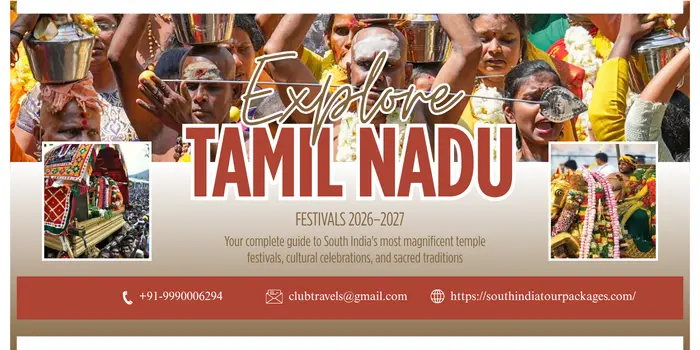
Your complete guide to South India’s most magnificent temple festivals, cultural celebrations, and sacred traditions
Tamil Nadu is not just a place to visit; it is a living and breathing calendar of worship and devotion. From the majestic throb of temple chariots rolling down ancient stone roads to the subtle gleam of a ghee lamp on a sacred hilltop, every season of the year in the venerable southern state is filled with the rhythm and color of worship and celebration. For the would-be traveler planning a trip to South India in 2026 or 2027, the most rewarding decision would be to synchronize the trip with the festival calendar of Tamil Nadu.
This definitive guide to the festivals of Tamil Nadu in 2026–2027 not only provides detailed information on more than twenty important celebrations of the region, but also helps travelers and tourists experience them firsthand. Moreover, whether you wish to witness the grand spectacle of the Madurai Chithirai Festival, enjoy the peaceful and floral charm of the Ooty Flower Show, or admire the awe-inspiring Maha Deepam at Tiruvannamalai, Tamil Nadu offers a diverse range of unforgettable experiences. Ultimately, each festival reflects the state’s rich culture and traditions, leaving visitors with memories that truly last a lifetime.
Tamil Nadu festivals 2026–2027
| Date | Festival Name | Venue |
| 1st April 2026 | Panguni Uthiram | Tiruparankundram, Madurai |
| 19th April to 4th May 2026 | Madurai Chithirai Festival 2026 | Meenakshi Temple, Madurai |
| Mid May 2026 | Ooty Flower Show | Government Botanical Garden, Ooty |
| around May 15th–25th 2026 | Kodaikanal Flower Show | Bryant Park, Kodaikanal |
| 25th May 2026 – 6 June 2026 | Brahmotsavam & Chariot festival | Varadaraja Perumal Temple, Kanchipuram |
| 28th May 2026 | Villianur Temple Car Festival | Sri Gokilambal Thirukameswarar Temple, Villianur, Pondicherry |
| 13 to 22 June 2026 | Aani Thirumanjanam Festival | Chidambaram Natarajar Temple, Chidambaram |
| 14th July | Bastille Day (National Day of France) | Pondicherry |
| June-July 2026 | Aani Thirumanjanam Festival | Chidambaram Natarajar temple, Chidambaram |
| 3rd August 2026 | Aadi Peruku | In regions along the Cauvery River and its delta. |
| 14th August 2026 | Aadi Pooram (Aandal Jayanti) | At Srivilliputhur Aandal Temple, Renganathar Temple in Sri Rangam, Jambukeshwarar temple in Tiruvanaikaval, Trichy & Kapaleeshwarar temple in Mylapore, Chennai |
| 15th August 2026 | Sri Aurobindo’s Birth Anniversary | Shri Aurobindo Ashram, Pondicherry |
| 24th August 2026 | Puttu Festival | Puttuthopu Thidal near Arappalayam at Madurai. |
| 17 September 2026 | Consecration Ceremony of Meenakshi Amman Temple | Meenakshi Amman Temple, Madurai |
| 11th October 2026 to 20th October 2026 | Navarathri celebrations / Dussehra | All over South India |
| 11th October 2026 to 20th October 2026 | Kulasai Dussehra | Kulasekarapattinam, Tuticorin District, Tamil Nadu |
| 22nd October 2026 | Raja Raja Cholan Sadhaya Vizha – Tanjore | Brihadeeswarar Temple, Tanjore |
| 25th October 2026 | Anna Abhishekam – Kumbakonam | Gangaikondacholapuram Temple |
| 15th November 2026 | Soorasamharam | Arulmigu Subramaniya Swamy Temple, Tiruchendur, Tamil Nadu |
| 24th November 2026 | Karthigai Deepam (Maha Deepam) at Tiruvannamalai | Arunachala hill, Tiruvannamalai |
| 20th December 2026 | Vaikunta Ekadasi | All Vishnu temples in South India |
| The exact date is yet to be finalised. | Music Festival | Chennai |
| approx. Dec 21, 2026 – Jan 20, 2027 | Mahabalipuram Dance Festival | Shore Temple, a UNESCO World Heritage Site in Mahabalipuram |
| 22nd January 2027 | Float Festival | Mariamman Teppakulam tank. |
| 14th January 2027 – 17th January 2027 | Thai Pongal (Harvest Festival) | All over Tamilnadu |
| 2nd to 6th March 2027 (tentative date) | Natyanjali Festival, a confluence of India’s Classical Arts | Chidambaram Temple, Chidambaram |
| 20th March 2027 | Arubathimoovar Festival (a Grand Shavite Celebration) | Kapaleeswarar temple, Chennai |
Disclaimer: The festival dates in Tamil Nadu are primarily determined according to the lunar calendar; therefore, they may vary slightly from region to region. Additionally, local customs and traditions can also influence the exact dates of celebrations. The dates mentioned here are approximate, and the exact dates will be available closer to the occasion.
For further information, please feel free to contact us; we will be happy to assist you and provide all the details you need.
Panguni Uthiram: 1st April 2026
Venue: Tiruparankundram, Madurai
In Tiruparankundram Murugan Temple, the celestial wedding of Lord Murugan is celebrated every year during March–April. On this auspicious day, Lord Sundareswarar and Goddess Meenakshi, the divine parents of Lord Murugan, ceremoniously visit Tiruparankundram to solemnize his marriage with Deivanai. Consequently, Meenakshi Amman Temple remains closed for devotees during this time.
- Unique Traditions: Thousands of devotees perform Kavadi Aattam, carrying decorated bamboo poles, or Paalkudam (milk pots), as acts of penance and gratitude. Devotees often observe a strict fast to seek blessings for marital harmony or to find a suitable life partner. The deities are taken on daily processions using various gold and silver vehicles like the Golden Peacock, Golden Horse, and Silver Goat.
Madurai Chithirai Festival 2026: 19th April to 4th May 2026
Venue: Meenakshi Temple, Madurai
The Madurai Chithirai Festival is a month-long celebration uniting Shaivism and Vaishnavism, featuring the celestial wedding of Goddess Meenakshi and Lord Sundareswarar, followed by Lord Kallazhagar’s historic procession from Alagar Hills to the Vaigai River. The festival re-enacts a 700-year-old tradition. The city of Madurai becomes a bustling centre of devotion, bringing together varied culinary, artistic, and traditional practices.
Key Events Schedule:
- 19th April 2026. The festival will commence with the flag-hoisting ceremony. Goddess Meenakshi will be taken in a procession in a lion-faced palanquin through the Masi streets of Madurai
- 26th April 2026. Meenakshi Pattabhishekam – Coronation ceremony of Goddess Meenakshi
- 28th April 2026: Meenakshi Thirukalyanam / Celestial wedding of Meenakshi and Sundareswarar
- 29th April 2026: Ther Thiruvizha / Grand chariot procession through Madurai’s streets
- 1st May 2026: Kallazhagar’s entry into the Vaigai River
Ooty Flower Show: Mid May 2026
Venue: Government Botanical Garden, Ooty
The 128th Ooty Flower Show in 2026 is expected to be held in mid-May at the Government Botanical Garden in Udhagamandalam. This flagship event of the Nilgiris Summer Festival features thousands of blooming flowers, rare plants, and artistic floral arrangements, typically attracting over 20 lakh visitors. The flower show is a highlight of the month-long summer celebration in the Nilgiris district. It’s an excellent opportunity to witness a spectacular display of flowers, with over 150 types and 52 varieties. Approximately 10,000 flowerpots are artistically placed to create a vibrant spectacle. It is organized in the Government Botanical Garden of Ooty. The show’s highlights include flower arrangements, flower rangoli, vegetable sculptures, bonsai, and cut flower shops with a wide variety of blossoms. The event is part of a larger Summer Festival featuring a Rose Show and Fruit Show.
Kodaikanal Flower Show: around May 15th–25th 2026
Venue: Bryant Park, Kodaikanal
The 63rd Annual Kodaikanal Flower Show is tentatively scheduled for mid-May 2026 (around May 15th–25th) at Bryant Park, serving as the highlight of the annual summer festival (Kodai Vizha). This popular event features elaborate flower structures, vegetable carvings, and cultural activities. The flower exhibition, a festival highlight, takes place in the middle of Kodaikanal at Bryant Park. Beautiful floral displays showcase the creativity and talent of local horticulturists. The flower exhibit showcases a wide range of flowers, including towering gladioli, tiny pansies, fragrant roses, spicy marigolds, and many other local and exotic blooms. The Summer Kodai festival also has vegetable sculptures, Rangoli competitions, cultural activities, food vendors, and boat races on Kodai Lake. The Summer Kodai festival provides an excellent opportunity to experience the beauty and culture of Kodaikanal. Evening performances featuring traditional folk dances like Bharatanatyam, Silambam, and Mayilattam.
Brahmotsavam & Chariot festival: 25th May 2026 – 6 June 2026
Venue: Varadaraja Perumal Temple, Kanchipuram
Brahmotsavam is the most significant annual festival of Kanchipuram, celebrated over ten days at the Varadaraja Perumal Temple in honour of Lord Varadaraja.
- Spiritual Significance: Believed to have been initiated by Lord Brahma, this festival holds deep religious importance and attracts large numbers of devotees.
- Processions & Key Highlights: The festival features daily processions of the deities through the temple streets, allowing devotees to receive blessings. Garudotsavam is a major highlight, drawing significant crowds.
- Chariot Festival: The grand Temple Car Festival on the ninth day is a key attraction, where devotees pull the chariot in a display of collective devotion.
- Cultural Experience: Brahmotsavam offers a rich blend of ritual, tradition, and community celebration—making it a valuable cultural experience for visitors.
Villianur Temple Car Festival – 28th May 2026
Venue: Sri Gokilambal Thirukameswarar Temple, Villianur, Pondicherry
It is a significant annual event held at the Sri Gokilambal Thirukameswarar Temple in Villianur, near Pondicherry, attracting devotees and visitors alike.
- Grand Chariot Procession: The highlight of the festival is the magnificent temple chariot, beautifully adorned with flowers and intricate carvings, which is pulled through the streets by devotees in a vibrant procession.
- Cultural Significance: This festival is a powerful expression of faith, community participation, and Pondicherry’s rich cultural heritage, offering a memorable experience for visitors.
Aani Thirumanjanam Festival: 13 to 22 June 2026
Venue: Chidambaram Natarajar Temple, Chidambaram
It is one of the most important festivals celebrated at the Chidambaram Nataraja Temple. It is a grand occasion that marks the sacred abhishekam (holy bath) of the revered Nataraja idol, commemorating the cosmic dance of Lord Shiva. The festival is held in the Tamil month of Aani (June-July), coinciding with the summer solstice. It is believed to hold immense spiritual significance, symbolising the purification of the soul and the renewal of life. Aani Thirumanjanam is a week-long festival, with the main rituals and abhishekam taking place on the full moon day of Aani. The festivities commence with flag hoisting and special prayers. The temple complex is adorned with vibrant decorations, and an air of devotion fills the atmosphere. On the day of the abhishekam, the Nataraja idol is ceremoniously taken out of the sanctum sanctorum and placed on a special platform in the temple courtyard. Devotees gather in large numbers to witness the sacred ritual. The abhishekam, is believed to cleanse the idol and bestow blessings upon devotees. The abhishekam is performed by a team of priests, following strict Vedic chants and procedures. The idol is bathed in various sacred liquids, including milk, curd, honey, panchamrita (a mixture of five nectars), and herbal concoctions. The priests also adorn the idol with sandalwood paste, flowers, and ornaments. Devotees eagerly catch the holy water dripping from the idol, believing it to possess immense purifying and healing powers.
Key HIghlight
- The highlight of the festival is the Therottam (chariot festival), where the imposing chariot carrying the idol of Nataraja is paraded through the streets of Chidambaram. Thousands of devotees throng the streets to witness this spectacle, creating an atmosphere of fervor and devotion
- Festival date: 13th to 22nd June 2026, Main attraction Chariot Festival – 21st June 26 & Aani Uthiram Darshan & Abhishekam – 22nd June 26)
Bastille Day (National Day of France): 14th July
Venue: Pondicherry
It is celebrated annually on July 14, commemorating the Storming of the Bastille in 1789, a pivotal event in the French Revolution symbolising liberty, equality, and fraternity. Situated along the Coromandel Coast, Pondicherry was once the hub of French trade and activities in southern India and Asia. As a significant former French colony in India, this day holds special significance for Pondicherry and is observed with great fervour, reflecting the enduring cultural ties between France and India. Bastille Day is also referred to as the ‘National Day of France’.
- Key Aspects: On the eve of Bastille Day, retired soldiers participate in parades, joining in the celebration with both the Indian and French National Anthems. On the day itself, uniformed soldiers march through the streets to honour the French soldiers who lost their lives in battle. Both the French and Indian flags are seen flying together, symbolising the blend of cultures and heritages. A dazzling fireworks display is held on the night of July 14th on the seafront near the French Consulate, attracting large crowds to the Beach Promenade.
Aani Thirumanjanam Festival: June-July 2026
Venue: Chidambaram Natarajar temple, Chidambaram
Aani Thirumanjanam is one of the most prominent festivals celebrated at the Chidambaram Nataraja Temple, marking the sacred abhishekam of Lord Nataraja and symbolising Lord Shiva’s cosmic dance. It is one of the most prominent celebrations held at the Chidambaram Nataraja Temple. It is a magnificent ceremony that commemorates the sacred abhishekam (holy bath) of the famed Nataraja idol and Lord Shiva’s cosmic dance. ural Festivities
- Spiritual Significance : It is thought to have profound spiritual significance, representing soul purification and life regeneration. Aani Thirumanjanam is a week-long celebration, with the primary rites and abhishekam occurring on the full moon day of Aani.
- Cultural Festivities : The activities begin with flag-raising and special prayers. The temple complex is decked with vivid decorations, and there is a strong sense of dedication in the air. On the day of the abhishekam, the Nataraja idol is ceremonially removed from the sanctum sanctorum and installed on a separate platform in the temple courtyard. Devotees come in great numbers to watch the sacred event. The abhishekam is thought to purify the idol and confer benefits to worshipers. A team of priests performs the abhishekam according to rigorous Vedic chants and rituals. The statue is immersed in a variety of sacred liquids, including milk, curd, honey, panchamrita (a blend of five nectars) and herbal concoctions. The priests also decorate the idol with sandalwood paste, flowers, and jewellery. Devotees eagerly collect the holy water falling from the idol, believing it to have incredible cleaning and healing properties.
- Key Highlight : The Therottam (chariot festival) is a highlight of the celebration, with an imposing chariot carrying Nataraja’s idol being carried through Chidambaram’s streets. Thousands of followers crowd the streets to see this spectacle, generating an aura of zeal and devotion.
Aadi Peruku: 3rd August 2026
Venue: In regions along the Cauvery River and its delta.
The Aadi Perukku festival, also known as Pathinettam Perukku, will be celebrated on Saturday, August 3rd, 2026. Observed on the 18th day of the Tamil month of Aadi (July-August), Aadi Perukku is a unique South Indian festival that honours the vital role of water in agriculture and daily life. Celebrated predominantly in Tamil Nadu, it marks the onset of the monsoon and the consequent rise in water levels in rivers and reservoirs. The festival is a form of gratitude towards nature, seeking blessings for prosperity and a bountiful harvest. Devotees gather along riverbanks, particularly the Cauvery River, to perform rituals and offer prayers to water deities. Aadi Perukku is not just a festival but a celebration of nature’s bounty, emphasising the harmonious relationship between humans and the environment. Aadi Perukku is a deeply cherished occasion, especially for young unmarried girls who seek divine blessings for a blissful marital life.
- Unique Rituals and Traditions: A core tradition for married women is replacing the yellow thread of their thaali (mangalsutra) with a new one. Newly married couples often visit riverbanks where the husband reties the thaali, symbolising a renewal of their marital bond and commitment. Devotees prepare edible lamps made from rice flour and jaggery. These are lit and floated on the river atop mango or banana leaves as an offering to the river goddess, typically Kaveri Amman. Young girls perform special pujas involving Kaadholai (palm-leaf earrings), Karugamani (black beads), and Kaapparisi (sweet hand-pounded rice) in the belief that they will be blessed with good husbands.
Aadi Pooram (Aandal Jayanti) – 14th August 2026
Venue: At Srivilliputhur Aandal Temple, Renganathar Temple in Sri Rangam, Jambukeshwarar temple in Tiruvanaikaval, Trichy & Kapaleeshwarar temple in Mylapore, Chennai
Aadi Pooram, also known as Aandal Jayanti or Thiruvadipooram, is one of the most significant festivals of Tamil Nadu, celebrated in honour of Goddess Aandal, the only female Alvar and an incarnation of Goddess Lakshmi.
- Significance: The festival marks the divine birth of Aandal, discovered by Saint Periyalvar at Srivilliputhur Aandal Temple. Known for her deep devotion to Lord Vishnu, Aandal composed the revered Tamil works Thiruppavai and Nachiyar Thirumozhi. Her spiritual union with Lord Ranganatha is the central theme of the celebration.
Key Celebrations
- Srivilliputhur: A grand 10-day festival culminating in Thirukalyanam (celestial wedding), with processions, poojas, and cultural programs.
- Trichy, Srirangam Ranganathaswamy Temple: Celebrations include divine wedding rituals and recitation of Andal’s hymns.
- Madurai Meenakshi Amman Temple: Special Valaikappu ceremony where bangles are offered and distributed, symbolising prosperity and protection.
- Other Celebrations: Festivities are also observed at Kapaleeshwarar Temple, Chennai and Akhilandeshwari Temple in Trichy with rituals, processions, and devotional programs.
- Essence: Aadi Pooram beautifully celebrates devotion, divine love, and Aandal’s timeless spiritual legacy, continuing to inspire generations of devotees.
Sri Aurobindo’s Birth Anniversary: 15th August 2026
Venue: Shri Aurobindo Ashram, Pondicherry
Sri Aurobindo’s Birth Anniversary is celebrated with great grandeur in Pondicherry on August 15, coinciding with India’s Independence Day, as he was born on this date in 1872 in Kolkata. Sri Aurobindo founded Integral Yoga, a spiritual practice, in Pondicherry. His vision focused on the transformation of human life into a divine life in a divine body. He believed in a spiritual awakening that not only emancipated but transformed human nature, allowing for heavenly life on earth.
- Ashram Celebration: The Sri Aurobindo Ashram becomes the main center of activity, drawing large numbers of devotees and visitors. The day begins with collective meditation around the samadhi (shrine) where Sri Aurobindo was laid to rest. Sri Aurobindo’s Birth Anniversary is commemorated every year through a celebration of his life work, vision, philosophy, and creative force for their relevance for the people of India and the world and in the life and realisation of Auroville.
- Key Highlight: Sri Aurobindo’s room, where he lived and carried out his spiritual work, is opened for public darshan. Devotees wait in long queues to visit this sacred space. A traditional bonfire meditation is held at the Matrimandir Amphitheatre in Auroville around 5:00 AM to mark the occasion.
Puttu Festival: 24th August 2026
Venue: Puttuthopu Thidal near Arappalayam at Madurai.
It is also known as the Puttu Thiruvizha, a religious festival celebrated in Madurai, Tamil Nadu, India. It is dedicated to Lord Shiva, particularly in his form as Puttu Sokkanathar. The festival commemorates a legend associated with Lord Shiva and a poor old woman who sold puttu, a steamed rice cake dish popular in Tamil Nadu and Kerala. According to the legend, the old woman was struggling to make ends meet. One day, Lord Shiva, disguised as a labourer, approached her and offered to help her carry bags of rice. After working diligently, he became very hungry and ate all the puttu she had prepared to sell. The old woman was initially upset, but Lord Shiva revealed his true form and blessed her, granting her moksha (liberation from the cycle of rebirth). The Puttu Festival is held annually during the Tamil month of Avani, which usually falls in August or September according to the Gregorian calendar.
Please note that clients who arrive at Madurai on this day will not be able to visit the temple as Meenakshi Amman Temple will be closed on this day. But they do have an option of witnessing this festival on the same day, evening, 6:00 pm at Puttuthopu Thidal near Arappalayam area at Madurai.
Consecration Ceremony of Meenakshi Amman Temple: 17 September 2026
Venue: Meenakshi Amman Temple, Madurai
The Madurai Meenakshi Amman Temple Kumbabhishekam is scheduled to take place on September 17, 2026, after 17 years, on the 31st of the month of Avani, between 7:45 am and 8:10 am. For this grand event, which will be held after 2009, the temple renovation work and the Veeravasantharaya Mandapam work will be completed by the end of March, and the Thirukkudamuzhu will take place in September. The Kumbabishekam is one of the most anticipated religious festivals in Madurai, expected to draw hundreds of thousands of devotees from across the globe. A unique post-Kumbabishekam belief in Madurai is the “Blessing Granted to All Living Beings.” It is traditionally believed that during such grand consecrations, Goddess Meenakshi’s grace extends beyond humans to all forms of life, including animals and plants, symbolizing universal protection.
Navarathri celebrations / Dussehra: 11th October 2026 to 20th October 2026
Venue: All over South India
Duration: 10 Days
Navaratri in Tamil Nadu is a unique nine-day festival dedicated to the feminine divine in three forms: Durga (power) for the first three days, Lakshmi (wealth) for the next three, and Saraswati (wisdom) for the final three. The celebrations are characterised by artistic doll displays called Golu, specialised legume-based offerings known as Sundal, and grand temple festivities. The most distinctive feature is the Golu (or Kolu), a tiered display of dolls set up in homes. Women and children visit each other’s homes to view the Golu, sing devotional songs (often Carnatic music), and exchange gifts like turmeric, Kunkum, and bangles.
Madurai Meenakshi Amman Temple features elaborate golu displays in the temple and special, traditional rituals dedicated to the goddess. Kanchi Kamakshi Amman Temple, Kanchipuram, celebrates Navarathri with great fervour, attracting large numbers of pilgrims for specialised, ancient rituals.
Kulasai Dussehra: 11th October 2026 to 20th October 2026
Venue: Kulasekarapattinam, Tuticorin District, Tamil Nadu
Dussehra in Tamil Nadu is famously celebrated as Kulasai Dasara at the Kulasekarapattinam Mutharamman Temple, a unique 10-day festival where devotees dress as gods, demons, or animals to portray divine energies, culminating in a dramatic victory over evil. It focuses on intense, raw devotion to Goddess Kali, often involving trances, street performances, and colourful costumes in a coastal setting. Devotees fast and dress in elaborate costumes—representing Kali, kings, monkeys, or beggars—treating it as a personal, spiritual transformation rather than a dramatic recreation. On the 10th night (Vijaya Dashami), a grand procession takes place, where the goddess kills Mahishasura on the beach, celebrating the victory of good over evil.
The most important part of the festivities is the Mutharamman Devi Temple, a 300-year-old temple dedicated to Goddess Mutharamman. During the festival, the temple and the entire town transform into a vibrant hub of religious and cultural activities.
Raja Raja Cholan Sadhaya Vizha – Tanjore: 22nd October 2026
Venue: Brihadeeswarar Temple, Tanjore
The Great Chola King Raja Raja Cholan’s birth anniversary is commemorated every year by celebrating “Sadhaya Vizha”. The festival is typically observed in the Tamil month of Aippasi, which runs from mid-October to mid-November. The Brihadeeswarar Temple, also known as the Tanjore Big Temple, hosts this celebration every year.
The Raja Raja Chola was a brilliant ruler and administrator of the Chola Dynasty who constructed several temples. There are various wonders to be found inside the Brihadeeswarar temple. The Sadhaya Vizha commemorates the celebration by adorning the statue of Raja Raja Cholan, which is located outside the temple, with silk robes. “Rajaraja Cholan brought the glory of the Chola Empire to the world. This great temple is not only a spiritual place but also a place of art, culture, and tradition. The event is being organized to throw light on the great ruler’s outstanding contribution to the development of his subjects.
The abhishekam (sacred bath) is done to the deity of Lord Peruvudaiyar. The deity, Lord Peruvudaiyar, is God Shiva in the shape of a lingam. The Perundheepa vazhipaadu (waving of lamps) and Swami purappadu (holy procession of the deity) inside the temple are observed on the day of the festival. Each year, thousands of devotees congregate at this temple to lavishly celebrate this festival.
Anna Abhishekam – Kumbakonam: 25th October 2026
Venue: Gangaikondacholapuram Temple
Abhishekam is the process of bathing the deity. “Annam” means rice, and Anna Abhishekam denotes bathing the deity with cooked rice. This divine ritual is performed on the Full Moon day in the Tamil month of Aippasi (mid-Oct to mid-Nov). Performing this ritual once a year can help you get rid of all the problems in your life. This ceremony is also known as Shiva Abhishekam or Maha Anna Abhishekam and is conducted in many Shiva temples throughout South India, particularly in Tamil Nadu. The rice is cooked in the temple premises, and then it is carried around the temple. Priests chant mantras, and musical instruments like Nadaswaram, drum, etc., are played.
The cooked rice is then used to cover the Shiva Linga, and it is referred to as Anna Linga. Various types of rice preparations like Pongal, curd rice, Sweet Pongal, tamarind rice, sesame rice, payasam, and other sweets from freshly harvested rice are prepared and offered to Lord Shiva on the day. The food is then shared by people and is also given to domesticated animals and birds. At the Arulmigu Brihadeeswarar Temple in Gangaikondacholapuram, this ceremony holds profound spiritual and cultural significance.
Soorasamharam: 15th November 2026
Venue: Arulmigu Subramaniya Swamy Temple, Tiruchendur, Tamil Nadu
Soorasamharam in Tiruchendur is the grand, annual reenactment of Lord Murugan defeating the demon Soorapadman, marking the victory of righteousness (dharma) over evil. Celebrated at the shore, it signifies the destruction of ego, maya, and karma, culminating in the demon’s transformation into Murugan’s mount, the peacock. The event symbolizes the triumph of righteousness (dharma) over demonic forces, inspiring devotees to overcome personal problems. Soorapadman’s surrender and subsequent transformation into the peacock (vahana) and rooster (flag) signifies that when surrendered to God, ego is refined into devotion.
The festival ends the following day with Thirukalyanam, the divine marriage of Lord Murugan and Devasena.
The festival is celebrated at all primary Murugan temples (Arupadaiveedu) in Tamil Nadu, including Palani, Tirupparankundram, Swamimalai, Vayalur, Thiruthani, and Pazhamudircholai.
Karthigai Deepam (Maha Deepam) at Tiruvannamalai: 24th November 2026
Venue: Arunachala hill, Tiruvannamalai
Karthigai Deepam, or “Festival of Lights,” is one of Tamil Nadu’s most important festivals. It commemorates the triumph of good over evil, as symbolised by the lighting of lamps with the big flame ignited atop Arunachala Mountain, which represents the light of knowledge conquering darkness. In Tiruvannamalai, it is even more significant because a giant ghee (clarified butter) lamp is lit atop the Arunachaleswarar Temple, symbolising Lord Shiva’s flaming appearance as a pillar of light. The event, also known as Karthigai Brahmotsavam, lasts ten days. Throughout the ten days, the temple hosts unique pujas (worship ceremonies) in honour of Lord Shiva.
- Key Highlight: The highlight of the festival is the lighting of the Maha Deepam (a gigantic ghee lamp) atop the Arunachaleswarar Temple. The event culminates with the lighting of the Maha Deepam (Great Lamp) on top of the temple. This lamp is lit in the evening, and the holy fire is claimed to be obtained via a specific yagna (fire ceremony) performed by temple priests. It’s a stunning sight, visible for miles. Thousands of devotees converge to see this breathtaking spectacle. Like Maha Shivaratri, devotees celebrate Girivalam by circumambulating the holy Arunachala peak. This is an important spiritual practice for believers during Karthigai Deepam (the full moon day) and contributes to the joyful ambience. During this festival, Tiruvannamalai’s accommodations tend to fill up rapidly.
Vaikunta Ekadasi: 20th December 2026
Venue: All Vishnu temples in South India
Vaikunta Ekadasi is one of the most sacred and significant Hindu festivals dedicated to Lord Vishnu. It is believed that on this day, the gates of Vaikuntha (Lord Vishnu’s celestial abode) are opened for devotees, offering a rare opportunity for spiritual liberation or moksha.
Key Highlight:
- The hallmark of this festival is the opening of a special northern entrance in Vishnu temples called the Vaikunta Dwaram or Uttara Dwaram. Passing through this gate is symbolic of entering the divine realm. Devotees observe a rigorous fast, often avoiding grains (especially rice) and water (Nirjala) to cleanse the body and mind. Staying awake all night (Jagaran) while chanting the Vishnu Sahasranama or other hymns is a common practice.
- In Sri Ranganathaswamy Temple, Srirangam, this is one of the grandest celebrations that takes place with the opening of Paramapada Vaasal (the Gateway to Heaven). The temple witnesses lakhs of devotees, special rituals, and Vaikunta Dwaram darshan from early morning. This day is part of the 21-day Vaikunta Ekadasi festival, which includes the famous Pagal Pathu (during the day) and Ira Pathu (during the night) utsavams.
- In Tirumala Tirupati – A massive influx of pilgrims will be there for Vaikunta Dwara Darshan at the Lord Tirupati Balaji Temple. Elaborate arrangements are made by Tirumala Tirupati Devasthanams (TTD) for crowd management and darshan.
- In Kerala, this festival is being celebrated in Guruvayur Temple, Thiruvananthapuram Anantha Padmanabha Swamy Temple, and other Vishnu shrines. Fasting, special poojas, and early morning darshan through the Vaikunta Dwaram are observed.
- In Karnataka, Melkote Cheluvanarayana Swamy Temple, Udupi Sri Krishna Matha, and Srirangapatna Ranganathaswamy Temple also holds important rituals during Vaikunda Ekadesi.
Music Festival: The exact date is yet to be finalised.
Venue: Chennai
The Chennai Music Festival, popularly known as the Margazhi Music Season, is one of the world’s largest cultural festivals dedicated to Carnatic music and classical dance. The festival is an annual cultural season held during the Tamil month of Margazhi (December–January). It began in 1927, centred on The Music Academy Madras. It showcases: Carnatic vocal and instrumental music, Bharatanatyam dance, Harikatha and classical discourses. It will be a month-long celebration of classical arts, filling the city with music, dance, devotion and cultural energy—especially in areas like Mylapore, T. Nagar, and Alwarpet.
Mahabalipuram Dance Festival: approx. Dec 21, 2026 – Jan 20, 2027
Venue: Shore Temple, a UNESCO World Heritage Site in Mahabalipuram
Duration: 30 Days.
The Mamallapuram Dance Festival is held annually in Mahabalipuram during December & January by the Department of Tourism, Government of Tamil Nadu. This 30-day extravaganza is a visual treat for art lovers. The breathtaking backdrop of the Shore Temple and the vibrant performances create a magical experience. Indian classical dances, including Bharatanatyam, Kuchipudi, Kathakali, Mohini Attam, Odissi, and Kathak, will be performed by well-known exponents of the art & performance will be on an open-air stage against the magnificent backdrop of the Pallava rock sculptures. Professional classical dance artists from across India will perform. Folk dancers add a vibrant local touch to the festival. The Dance festival has evolved as one of the major cultural attractions of the southern state of India.
Float Festival: 22nd January 2027
Venue: Mariamman Teppakulam tank.
Meenakshi Amman temple remains closed for the devotees on this festival day
Each and every year, the float festival (Known as Theppam festival in Tamil) is celebrated during January- February (On the day of Poosam star) on a full moon day at Shri Mariamman temple, Theppakulam – A Large Tank. In a Decorated palanquin, The Idols of Sri Meenakshi Amman, Swami Sundareshwarar are taken to the Theppakulam. A huge crowd are gathered at this place to witness this festival. Due to this, Shri Meenakshi Amman Temple remains closed on that day, and the guests will not be able to visit the temple; alternatively, they can witness this festival at Shri Mariamman Tank/Temple.
Thai Pongal (Harvest Festival): 14th January 2027 – 17th January 2027
Venue: All over Tamilnadu
- 14th January 2027: Bhogi Pongal : Bhogi Pongal, the first day of the four-day Pongal harvest festival in South India, symbolises renewal and spiritual cleansing by shedding the old to embrace the new. People clean their homes and burn old, unused household items to symbolise letting go of the past and removing negative energy. Bhogi is dedicated to Lord Indra, the king of the gods and the rain god. Farmers pray to him to bless the land with prosperity, good rains, and a bountiful harvest. It marks the day before the main Thai Pongal, preparing households to welcome fresh agricultural produce and new beginnings.
- 15th January 2027: Thai Pongal : The main day, Thai Pongal, is a thanksgiving to the Sun God (Surya) for a bountiful harvest, typically celebrated by cooking rice in clay pots in the open courtyard, allowing the milk and rice to “boil over”—symbolising overflow of prosperity. Thai Pongal marks the start of the Tamil month of Thai, which is considered a harbinger of good luck and new opportunities (“Thai Pirandhal Vazhi Pirakkum”).
Key Highlight:
The highlight is cooking a dish called Pongal, a sweet rice dish prepared using freshly harvested rice, milk, jaggery, and ghee. It is boiled in an earthen pot until it overflows, symbolising prosperity. The moment the milk boils over (symbolising abundance), everyone shouts “Pongalo Pongal!”
- 16th January 2027: Mattu Pongal : Mattu Pongal, celebrated on the third day of the Tamil harvest festival, is crucial in villages for honouring cattle (cows and bulls) as integral partners in agriculture. It emphasises gratitude, with farmers decorating cattle with garlands and painted horns, offering them special sweet rice (Sakkarai Pongal), and praying for their health and continued prosperity. Cattle are treated as sacred, as they provide milk and assist in ploughing fields, making them vital for rural livelihoods.
- Jallikattu is a 2,000-year-old Tamil bull-taming sport held during the festival to celebrate culture, valour, and native cattle conservation. It symbolises Tamil heritage and rural identity, honouring the close bond between farmers and bulls, where participants grab a bull’s hump to win prizes.
- The most famous places to witness Jallikattu are concentrated in the Madurai district of Tamil Nadu. The three events at Avaniyapuram, Palamedu and Alanganallur are considered the most prestigious and draw the largest crowds, often featuring thousands of bulls and hundreds of tamers. They attract significant international attention and are often flagged off by high-ranking officials.
- 17th January 2027: Kannum Pongal : Kaanum Pongal, the fourth and final day of the Tamil harvest festival, signifies reunion, gratitude, and community bonding. Meaning “to view/visit,” it is a day of relaxation where families visit relatives, picnic at beaches or parks, honour siblings, and offer thanks to nature, often featuring traditions like Kaanu Pidi. The day often showcases traditional folk dances like Mayilattam (peacock dance) and Kolattam (stick dance).
Natyanjali Festival, a confluence of India’s Classical Arts: 2nd to 6th March 2027 (tentative date)
Venue: Chidambaram Temple, Chidambaram
The Chidambaram Nataraja Temple celebrates several festivals throughout the year, with the Natyanjali Dance Festival being the prominent one, where dance meets divinity. Natyanjali literally means “offering of dance,” paying homage to Lord Shiva in his form as Nataraja, the cosmic dancer.
It’s a five-day extravaganza held during the Tamil month of Maasi (February-March), coinciding with Maha Shivaratri, making it spiritually and culturally vibrant.
Highlight:
- The festival is a fusion of art and faith, which brings together dancers from across India to showcase their talents and pay their respects to Lord Shiva. The rhythmic footwork, graceful movements, and expressive storytelling through dance create a mesmerising atmosphere.
- Cultural evenings and musical excellence: The evenings come alive with Carnatic music concerts, featuring renowned artists who enthral audiences with their soulful renditions of devotional songs dedicated to Lord Shiva. It’s an excellent opportunity to experience the rich cultural heritage of Tamil Nadu.
- A valuable cultural experience for clients: Natyanjali offers an exceptional opportunity for travellers to witness India’s rich artistic heritage in a deeply spiritual setting. For dancers, it is a prestigious platform; for visitors, it is a memorable cultural highlight.
- A confluence of India’s Classical Arts: The festival brings together acclaimed dancers from across India, presenting classical forms such as Bharatanatyam, Kuchipudi, Odissi, Kathak, Mohiniyattam, and Chhau within the temple precincts.
Arubathimoovar Festival (a Grand Shavite Celebration): 20th March 2027
Venue: Kapaleeswarar temple, Chennai
It is one of the grand festivals of Kapaleeshwarar Temple in Mylapore. This festival honours the 63 Nayanmars, the revered Shaivite saints, whose devotion to Lord Shiva is celebrated with great reverence.
- Sacred Procession of Deities: A key highlight of the festival is the grand procession, where the idols of all 63 Nayanmars are taken out on beautifully decorated palanquins. They are accompanied by the deities of Kapaleeshwarar, Karpagambal, Ganesha, Murugan, and Chandikeswarar, creating a spiritually uplifting and visually magnificent spectacle.
- Timings & Festive Atmosphere
The procession typically commences around 15:00 hrs and continues until approximately 22:30 hrs. The streets of Mylapore come alive with thousands of devotees and visitors who gather to witness this remarkable event. - Visitor Advisory & Logistics
Due to the large crowds and festival arrangements, vehicle access in and around the temple area is restricted. Visitors are required to park at designated areas away from the temple and may need to walk approximately 1.5 km to reach the venue.
Travel Tips for Tamil Nadu Festival Tourism
Getting the most from your Tamil Nadu festival experience requires some thoughtful planning. Here are the key things every visitor should know.
🗓️ Book Early: For the Madurai Chithirai Festival (April), Karthigai Deepam (November), and Vaikunta Ekadasi (December), book hotels 3–6 months ahead. These cities fill completely.
🛕 Temple Closures: Meenakshi Amman Temple in Madurai closes on Panguni Uthiram (Apr 1), Puttu Festival (Aug 24), and Float Festival (Jan 22). Plan alternate visits accordingly.
👘 Dress Code: Wear modest, traditional attire at all temple festivals. Men should wear dhotis or lungis at major Shaiva and Vaishnava temples. Remove footwear at all temple premises.
📅 Lunar Dates: Many Tamil Nadu festival dates are determined by the lunar calendar and can shift by 1–2 days. Always confirm specific dates with local temple authorities closer to your visit.
🚌 Transport: During chariot festivals and major processions, roads around temples are closed. Use public transport or walk. For Arubathimoovar in Mylapore, park 1.5 km away.
📸 Photography: Photography is generally permitted at public processions and outside temple sanctums. Always ask before photographing inside inner shrines or during sacred abhishekam rituals.
Tamil Nadu Festivals 2026 — FAQ
The Madurai Chithirai Festival (April 19 – May 4, 2026) is widely considered the grandest Tamil Nadu festival, drawing millions of visitors for the celestial wedding of Meenakshi and Sundareswarar. The Meenakshi Amman Temple Kumbabhishekam on September 17, 2026 — held after 17 years — will also be a once-in-a-generation event.
Thai Pongal 2027 falls on January 15. The four-day Pongal festival runs from January 14 (Bhogi Pongal) to January 17 (Kaanum Pongal) and is celebrated across all of Tamil Nadu with harvest rituals, the famous Jallikattu bull-taming sport, and family gatherings.
The 128th Ooty Flower Show is expected to be held in mid-May 2026 at the Government Botanical Garden, Udhagamandalam (Ooty). It is part of the Nilgiris Summer Festival and typically attracts over 20 lakh visitors.
Karthigai Deepam 2026 falls on November 24 at Tiruvannamalai. The 10-day Brahmotsavam festival culminates on this date with the lighting of the Maha Deepam — a giant ghee lamp atop Arunachala hill — visible for miles across the landscape.
The Natyanjali Dance Festival is a five-day classical dance festival held at the Chidambaram Nataraja Temple, tentatively March 2–6, 2027. Coinciding with Maha Shivaratri, it brings together India’s leading classical dancers performing Bharatanatyam, Kuchipudi, Odissi, Kathak, Mohiniyattam, and Chhau as offerings to Lord Shiva Nataraja.
Yes — virtually all Tamil Nadu festival processions, chariot festivals, and outdoor events are open to everyone. Entry to temple sanctums (garbhagriha) may be restricted to Hindus at certain temples. Always verify dress code and entry rules with the specific temple in advance.